Be there or be square. Ideally, as a goalie, you want to be both.
Your goalie should be in the correct position on the ice and square to the puck. But what does it mean to be square to the puck?
The short and simple answer, is the shoulders and feet of a goalie (in their stance), should be perpendicular to the line drawn from the puck to the center of the net.
Sounds complicated, so let’s see if some pictures will help!
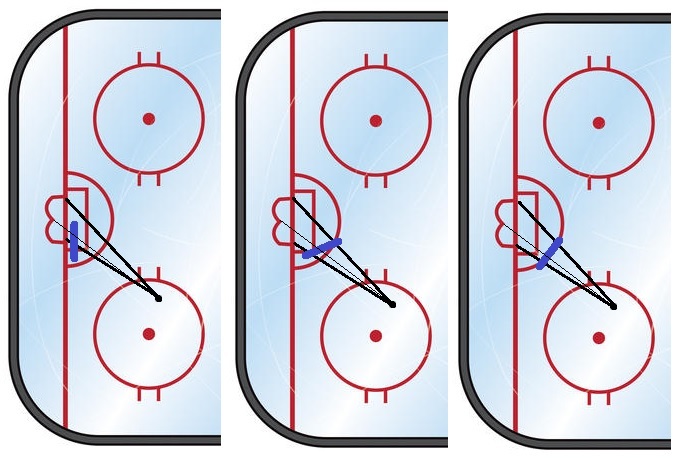
Hopefully, now you’re starting to grasp what “square to the puck” means. It’s different than angles and depth. If you’re confused about what angles and depth are, refer back to the Knowledge on angles and depth.

Have you noticed anything in the phrasing throughout this article? It’s square to the “puck,” not the shooter. It’s very easy for your goalie to fall into the habit of facing the shooter, but there is a difference.
If you look at the stock photo above, you’ll see that the red arrow of the goalie’s stance and shoulders is pointed at the player rather than the puck. See how the left side of the net is now open? If this goalie were square to the puck, they’d be in a much better position to make the save.
Another way to think of this is from the puck’s perspective. It sees a square-shaped net. You, as the goalie, need to fill up as much of that square as possible. So if you are the square (no, we’re not talking meditation), then you’re in the best position to make the save. If you’re only filling up half the square the puck sees, or rotated in that square picture, you’ll leave some gaps for the puck to see.
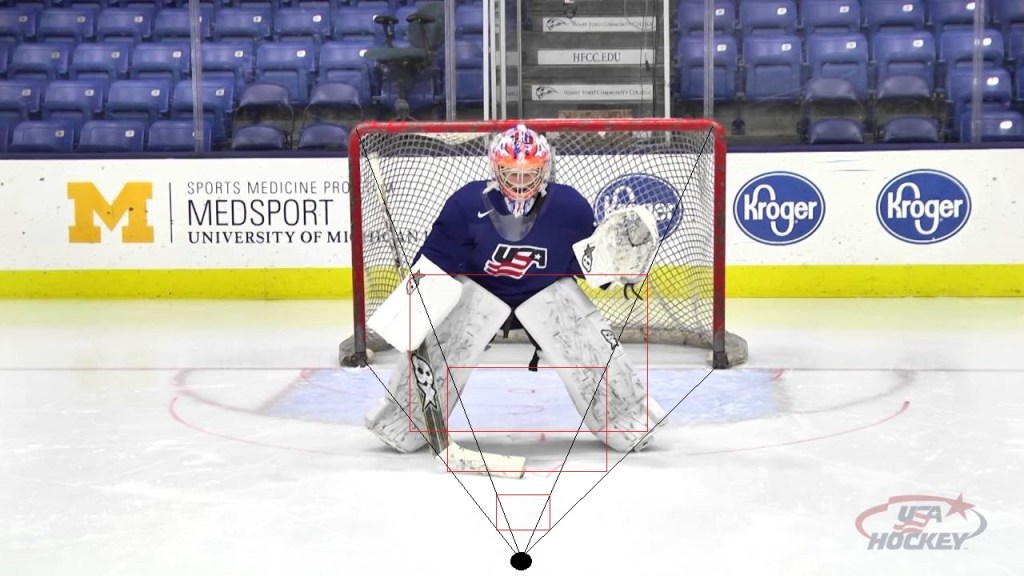
Don’t overthink what being square to the puck means. Make sure your goalie is staying between the puck and the net. If you’re still having trouble, leave a comment or feel free to reach out with any questions you have or how to improve with this concept. Thanks for reading!
 maxhockeycoaching.com
Leave a comment